
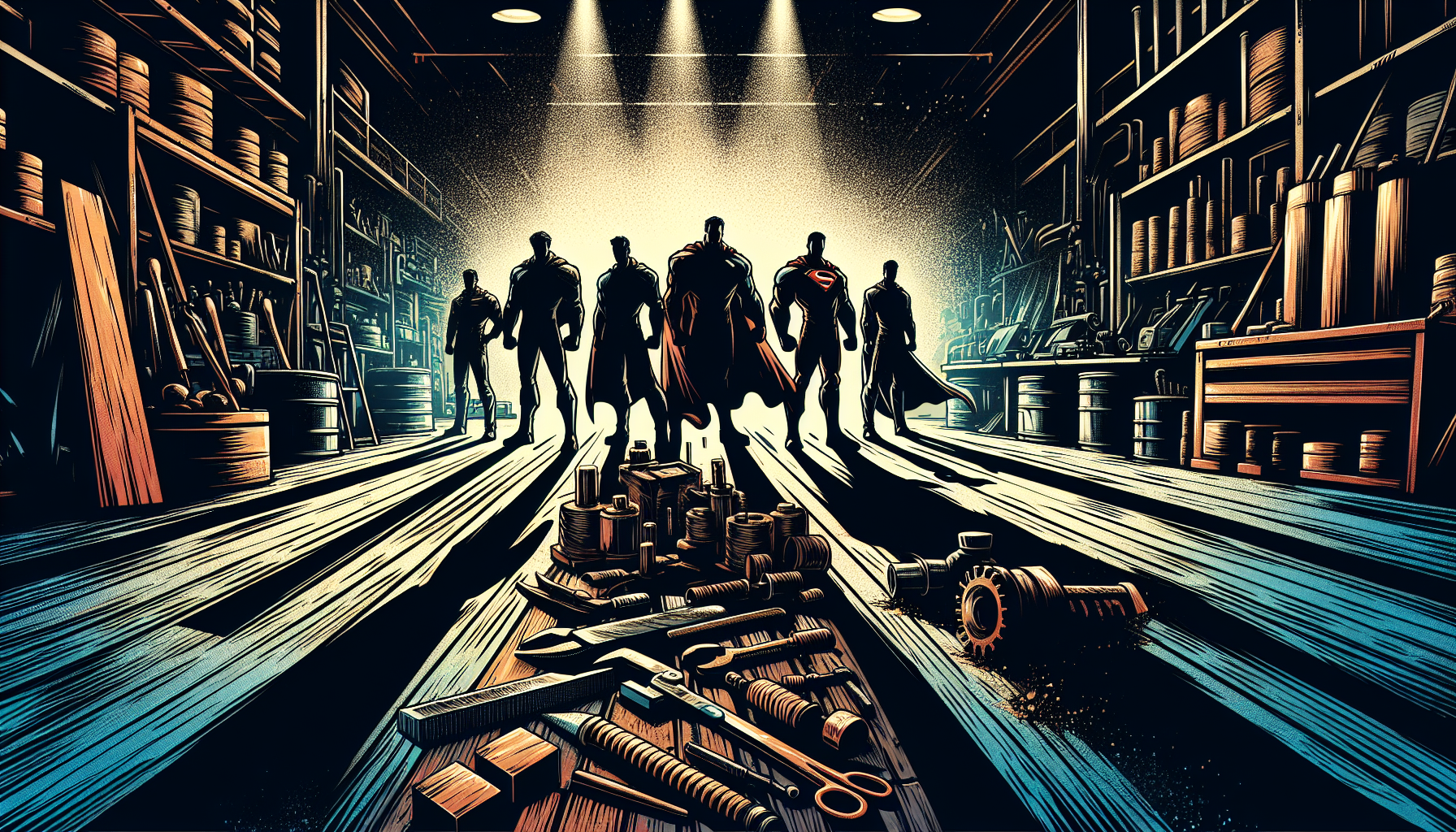
If your workshop could form a superhero team, it would be the most dysfunctional one in comic book history. Because here’s the truth nobody tells you when you start woodworking: every single workshop tool has a personality, and most of them are firmly on the wrong side of the moral alignment chart. We are not here to judge. We are here to rank them.
Why Workshop Tools Have Personality (and Why Most of Them Are Villains)
Think about it. A good hero is reliable, self-sacrificing, does the job quietly and never asks for recognition. Does that sound like any tool you have ever owned? No. Your router screams like it’s auditioning for a heavy metal band. Your belt sander leaves a trail of destruction and dust across every surface in a twenty-foot radius. Your table saw just sits there in the corner radiating pure menace. These are not heroes. These are characters with complicated backstories and dubious motivations.
The more you dig into workshop tools personality archetypes, the more the comic book comparisons just write themselves. So we wrote them. You’re welcome.
The Table Saw – Absolute Big Boss Energy
The table saw is Dr Doom. It’s Thanos. It’s that villain who has a point but takes things way, way too far. It dominates every room it occupies. Every other tool unconsciously angles itself slightly away from the table saw, just to avoid eye contact. It demands respect, it demands proper technique, and if you forget either of those things for even half a second, it will remind you in a manner that is both immediate and unforgettable.
The table saw does not apologise. The table saw has never once considered apologising. It has a fan club and a body count and it wears both with equal pride.
The Belt Sander – Chaotic Neutral, Definitely Not to Be Trusted
If the table saw is the brooding mastermind, the belt sander is the unhinged sidekick who keeps accidentally blowing things up. It has tremendous energy. It wants to help. It just cannot guarantee what state your project will be in when it’s done helping. Belt sanders are the Harley Quinn of workshop tools – wildly entertaining, genuinely useful in the right hands, and absolutely not something you leave unattended near anything you care about.
The workshop tools personality of a belt sander could be summarised as: “intentions: good, execution: spectacular disaster, regrets: none.”
The Hand Plane – Secretly the Most Dangerous One in the Room
Everyone underestimates the hand plane. It looks old-fashioned. It’s quiet. It just sits there on the shelf looking like something your grandfather owned. And then you pick it up, and you suddenly understand why woodworkers who’ve been doing this for forty years still get that slightly unhinged gleam in their eyes when someone mentions sharpening angles.
The hand plane is Magneto. Technically capable of tremendous good. Quietly convinced it is better than everyone else in the room. Absolutely correct on that last point.
The Bandsaw – The Eccentric Genius Nobody Fully Understands
Bandsaws can cut curves. They can resaw timber. They can do things no other tool in the workshop can even attempt. They are also deeply, consistently unpredictable in ways that no manual quite prepares you for. Blade tension? A philosophy as much as a measurement. Drift angle? A mood, not a fixed quantity.
The bandsaw is the workshop’s resident mad scientist. Brilliant. Unconventional. Makes incredible things happen and refuses to explain exactly how. If you want a machine that rewards patience and punishes arrogance, the bandsaw is your tool. Whether you get one new or hunt down used woodworking machinery at a bargain, the bandsaw will immediately let you know who is in charge, and it is not you.
The Cordless Drill – The Overenthusiastic New Recruit
Every workshop needs one genuinely heroic presence, and reluctantly, we’re giving that slot to the cordless drill. It’s eager. It shows up charged and ready. It does not complain. It will drill holes, drive screws, mix paint if you ask nicely, and then sit happily in its charger waiting for the next assignment. The cordless drill is basically a golden retriever that someone gave a job and a uniform.
In a team full of brooding antiheroes and outright chaos agents, the cordless drill is the one writing motivational quotes on the team whiteboard. Everyone else finds it slightly annoying. Everyone would be lost without it.
The Router – Pure Chaos in a Handles-and-Motor Package
The router is the Joker. Not open for debate. It spins at terrifying RPM, it will destroy your project if you go the wrong direction, it produces a sound that makes nearby pets genuinely reconsider their life choices, and yet – in the hands of someone who has truly mastered it – it creates things of extraordinary beauty. The workshop tools personality that the router embodies is essentially: “I contain multitudes, most of them screaming.”
Respect the router. Fear the router. Never turn your back on the router.
So What Does Your Workshop Say About You?
The tools you gravitate towards say something about your personality. Router enthusiasts are chaos-tolerant creative types who probably also enjoy extremely spicy food. Hand plane devotees are perfectionists who have strong opinions about sharpening stones and eye contact. Table saw people are pragmatists who have accepted the possibility of drama and decided to proceed anyway.
Whatever your workshop tools personality alignment, the point is this: your tools are not neutral objects. They are characters. Give them the respect, the fear, and frankly the narrative arc they deserve. Your workshop isn’t just a place where things get made. It’s the most interesting ensemble cast you’ll ever assemble – and someone in there is definitely planning something.

Workshop tools personality FAQs
What tool is considered the most dangerous in a home workshop?
The table saw is widely considered the most statistically dangerous tool in a home workshop due to its power, blade exposure, and the speed at which accidents can occur. Proper safety guards, push sticks, and a healthy respect for the machine make a significant difference. It is the one tool that really does demand your full attention every single time.
Is a router hard to learn for beginners?
Routers have a steeper learning curve than many other workshop tools because direction of feed, depth of cut, and bit choice all matter enormously. Beginners often find them intimidating at first due to the noise and vibration. Starting with a fixed-base router on simple edge profiles before moving to freehand or table-mounted routing is the sensible path forward.
What is the most versatile tool you can have in a workshop?
The bandsaw is frequently cited as one of the most versatile workshop tools because it can rip, crosscut, resaw, and cut curves – tasks that would require multiple other machines. A well-tuned bandsaw with the right blade for the job genuinely surprises people with its range. The cordless drill is a close second for sheer everyday utility.
What should beginners buy first when setting up a woodworking workshop?
Most experienced woodworkers recommend starting with a good cordless drill, a jigsaw, and a random orbital sander as the core beginner trio – tools that are versatile, forgiving, and relatively safe to learn on. A workbench and good hand tools like chisels and a hand saw should also be early priorities. The big stationary machines can come later once you know what kind of work you actually enjoy doing.
Are second-hand woodworking tools worth buying?
Absolutely – older woodworking machines are often built to a higher standard of durability than many modern equivalents, and buying second-hand is a smart way to access quality equipment at a fraction of the new price. The key is inspecting carefully for blade condition, motor function, and fence alignment before purchasing. Vintage cast iron table saws and band saws in particular are sought after for their weight, stability, and longevity.
Leave a Reply