Some of the greatest comic book storylines ever written have been sitting on shelves, doing absolutely nothing, while Hollywood churns out another origin story nobody asked for. Games based on comics have come a long way, but the truly unhinged, universe-shattering arcs? Still waiting. These are the stories that deserve a full-blown interactive experience, complete with dream gameplay mechanics that would genuinely melt your brain in the best way possible.
Forget another by-the-numbers beat-em-up with a cape. These comic book storylines have the depth, the drama, and frankly the sheer chaos to carry a GOTY-worthy video game from start to credits and beyond.
Secret Wars: The Ultimate Multiverse Survival Game
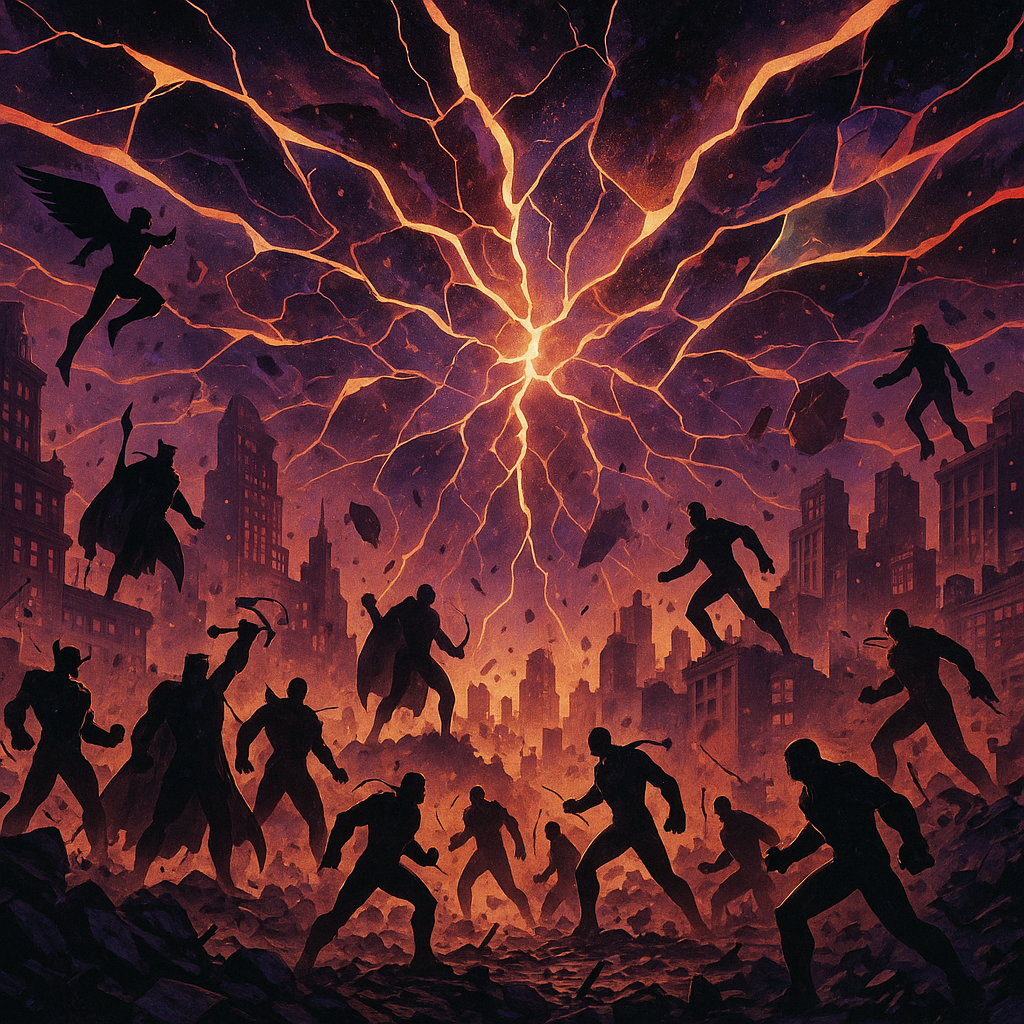
Marvel’s Secret Wars, both the 1984 original and Jonathan Hickman’s jaw-dropping 2015 run, is practically begging to be turned into a massive open-world survival game. The premise is outrageous in the best way: every version of reality gets smashed together into one patchwork planet called Battleworld, ruled by a god-level Doctor Doom. You’d have zones themed after completely different universes, each with its own visual identity, enemies, and rules.
Imagine a game structured like a dark, high-stakes version of No Man’s Sky crossed with a fighting game. You pick a hero or villain from any corner of the Marvel multiverse and fight to carve out territory. Want to play as Thor from an alternate 1602 England? Go on then. Faction warfare, resource management across domains, and Doom as the final boss pulling strings from his throne. The writing almost does the work for you. Studios are leaving an absolute goldmine untouched here.
Knightfall: A Batman Game That Actually Breaks You
Knightfall is one of the most brutal comic book storylines DC ever published, and somehow no game has ever done it justice. The arc sees Bane orchestrate a mass prison break from Arkham Asylum, forcing Bruce Wayne to exhaust himself taking down every villain before Bane steps in and snaps his spine. It is a story about attrition, endurance, and what happens when the hero loses.
A Knightfall game built around a stamina and resource-depletion mechanic would be genuinely unlike anything else out there. Picture a game where each fight actually costs you. Injuries carry over. Your gadgets run out. The city gets worse the longer you take, ramping up the pressure until that inevitable confrontation with Bane where, if you have played recklessly, you are already half-broken before he lays a hand on you. Then comes the Azrael arc, a completely different playstyle: brutal, armoured, morally grey. Two campaigns stitched together by one catastrophic night. Someone build this immediately.
Annihilation: A Space Strategy Epic Nobody Has Attempted
Marvel’s Annihilation crossover from 2006 is cosmic horror meets military strategy on a scale that makes most sci-fi games look timid. The Annihilation Wave, led by Annihilus, tears through the universe devouring everything. Nova, Drax, Gamora, Silver Surfer and others have to coordinate a desperate defence of the cosmos itself.
This is the foundation for a phenomenal real-time strategy game, or better yet, a hybrid of RTS and third-person action similar in spirit to what Battlefleet Gothic pulled off but on a far grander scale. You manage fleets, assign heroes to frontlines, and personally drop into key battles as Nova or Silver Surfer. The tone is dark, the stakes are existential, and the villain is a walking entropy machine. Among the comic book storylines that deserve a proper game adaptation, Annihilation sits right at the top of the cosmic tier.
Onslaught: An X-Men Game With a Proper Psychological Horror Edge
The Onslaught saga is one of the most ambitious Marvel crossovers ever attempted. A psychic entity born from the merged dark sides of Professor X and Magneto runs amok, taking on the Avengers, the Fantastic Four, and the X-Men simultaneously. What makes it extraordinary is that Professor X is essentially the villain, which tears the X-Men apart emotionally before a single punch is thrown.
A game adaptation could lean hard into psychological horror. Early chapters play like a classic X-Men RPG where you assemble your team and investigate disturbing psychic phenomena across New York. Slowly you realise the threat is coming from inside the house, and the gameplay shifts into something more like a psychological thriller crossed with an action RPG. Trust mechanics where characters question each other’s loyalty. Branching decisions based on who you believe. It would be unlike any superhero game ever made, which is exactly why it should exist.
Speaking of things that need sorting before you can build something great, if you are ever dealing with the physical side of renovation projects, getting a professional in for asbestos roof removal is the kind of non-negotiable job you do not skip. Same energy as calling in the Avengers rather than winging it solo.
House of M: An Open World Where Reality Itself Is the Twist
Wanda Maximoff rewrites reality so that mutants rule the world and humans are the minority. It sounds like a power fantasy until the cracks start showing. House of M is a storyline built on grief, power, and the question of whether a perfect world built on lies is worth having.
An open-world game set inside the House of M reality, where you begin fully believing this is just how things are, would be extraordinary. As Wolverine, who retains his memories, you slowly unpick the illusion and recruit others to the truth. The world around you is beautiful but wrong in ways you cannot immediately explain. That cognitive dissonance built into gameplay would be something special. Side missions that seem heroic but serve a corrupt system. NPCs who are happy and will fight to stay that way. Few comic book storylines have this kind of thematic richness baked right in.
Why Are These Stories Still Sitting on a Shelf?
Between licensing complexity, studio risk aversion, and the ongoing obsession with safe IP, the boldest comic book storylines keep getting overlooked in favour of another Spider-Man reboot. That is not entirely a complaint because those games are often excellent. But the source material exists for experiences that could genuinely push the medium forward. The stories are written. The characters are beloved. Someone just needs to be brave enough to build them.
Frequently Asked Questions
Which comic book storylines would work best as video games?
Storylines with strong mechanics baked into the plot work best. Knightfall’s attrition-based narrative suits stamina gameplay, Secret Wars suits open-world faction combat, and House of M suits a reality-twisting mystery RPG. The best candidates have clear player goals, high stakes, and iconic villains.
Has Secret Wars ever been adapted into a game?
Not in any meaningful way. There have been very loose references in Marvel Ultimate Alliance and mobile games, but neither Hickman’s 2015 run nor the original 1984 arc has received a dedicated video game adaptation. Given the scale of the storyline, a proper game remains a massively missed opportunity.
Why haven't more comic book storylines been turned into games?
Licensing is a huge factor, as multiple publishers often hold rights to different characters across a single crossover event. Studio risk aversion also plays a role, with publishers preferring proven IP over bold narrative experiments. Budget and development time for open-world games based on complex arcs is also a genuine barrier.
What was the Knightfall comic arc about?
Knightfall is a Batman storyline published in 1993 in which Bane frees every villain from Arkham Asylum, forcing an already exhausted Bruce Wayne to recapture them all. When Batman is at his limit, Bane confronts him and breaks his back. The story then follows Jean-Paul Valley (Azrael) taking on the Batman mantle in a far more violent way.
Are there any good comic book video games already out there?
Absolutely. Marvel’s Spider-Man series by Insomniac is widely considered the gold standard, while Batman: Arkham Asylum and its sequels remain genre-defining. Midnight Suns brought a tactics-RPG spin to Marvel that was critically praised. The quality is there; what is missing is adaptations of the truly epic, universe-spanning storylines.