Hollywood has spent decades selling us a gleaming, terrifying future where memory can be purchased like a package holiday, criminals are arrested before they’ve done anything wrong, and robot dogs patrol government buildings. Thrilling stuff. The only problem is that roughly 90% of these sci-fi movie technologies would be dead on arrival the moment a junior compliance officer at the ICO glanced at the pitch deck. Britain’s regulatory infrastructure is, frankly, a magnificent force of nature. Give it a whiff of unlawful data processing and it descends like a very polite, very serious avalanche of enforcement notices.
This isn’t a complaint. Most of the tech below is genuinely horrifying. But there is something deeply funny about imagining a GDPR assessment form being filled out for a machine that erases your personality and replaces it with someone else’s memories. Let’s work through the hall of shame.
Total Recall’s Memory Implants: A Data Protection Nightmare on Mars
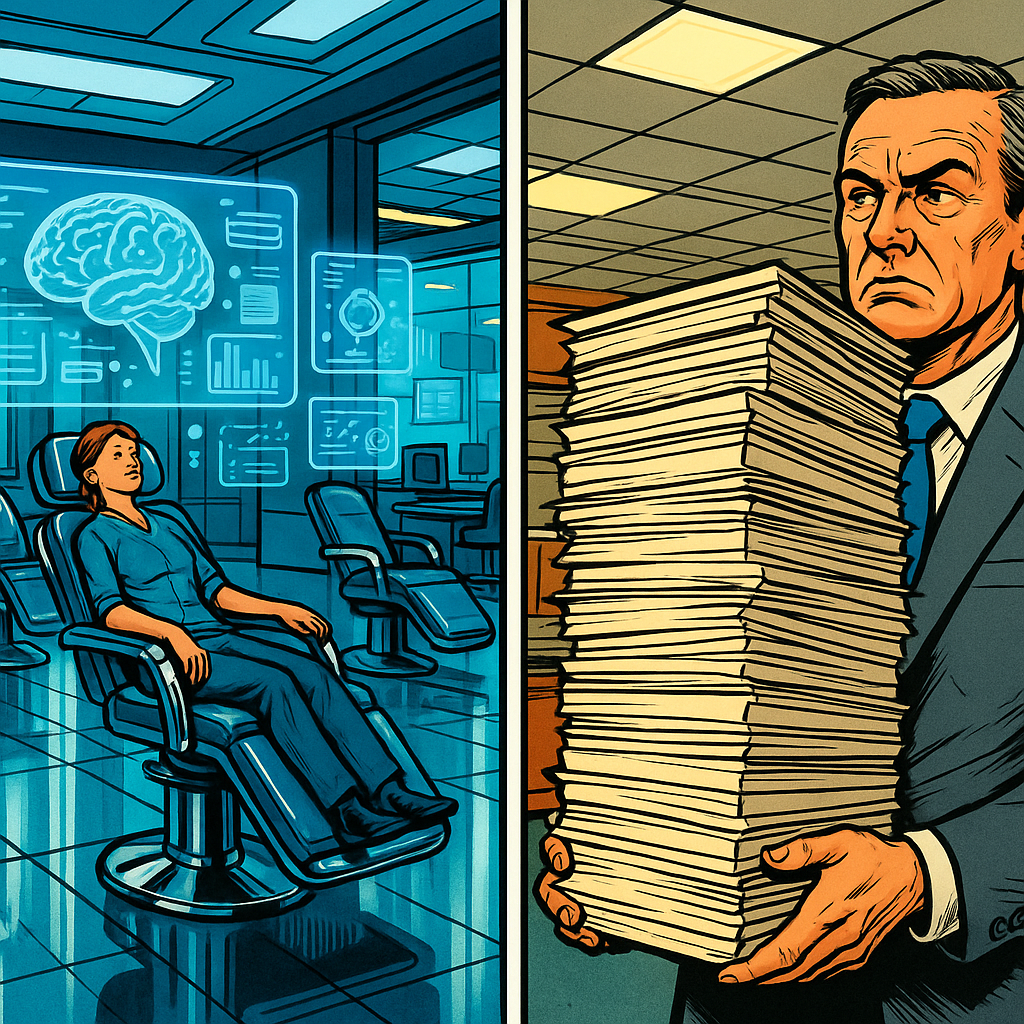
Rekall, the company at the centre of Total Recall, sells implanted holiday memories. You sit in a chair, they wire up your brain, and suddenly you’ve “been” to Mars. Lovely concept. The ICO would have the shutters down before the first client woke up from the chair.
Under UK GDPR, biometric data processed for the purpose of uniquely identifying a natural person is classified as special category data. Your brain is, presumably, fairly unique. Directly writing to it, reading from it, and storing a record of its existing contents before overwriting them represents the most catastrophic possible breach of data minimisation principles. There is no lawful basis. “Legitimate interest” does not cover lobotomising someone so they believe they went on a trip to a red planet. The ICO’s maximum fine is £17.5 million or 4% of global annual turnover. Rekall would be paying both before lunch.
Minority Report’s Pre-Crime Unit: Automated Decision-Making Gone Completely Feral
The Pre-Crime division arrests people for murders they haven’t committed yet, based on the visions of three psychic humans floating in a paddling pool. Setting aside the obvious problem of the psychics themselves (more on that shortly), the automated profiling system feeding data to law enforcement would trigger Article 22 of UK GDPR immediately.
Article 22 gives individuals the right not to be subject to decisions based solely on automated processing that produce legal or similarly significant effects. Being arrested is, one would reasonably argue, a significant effect. There would need to be human review. The humans in this case are the floating psychics, who are legally enslaved and in a state of chemical sedation, which raises about forty separate issues for the CQC and the Home Office before we even get back to the data problem.
The Metropolitan Police piloted live facial recognition cameras as recently as 2020 and faced sustained scrutiny from civil liberties groups and the ICO. Actual pre-crime AI would generate a legal challenge visible from orbit. You can read more about how UK regulators currently approach automated surveillance on the ICO’s official AI and data protection guidance pages.
The Matrix’s Neural Jack: Ofcom Would Like a Word About Spectrum Allocation
Inside the Matrix, every human mind is wirelessly connected to a vast simulated reality broadcast by the machines. This is, technically, a wireless telecommunications network of extraordinary scale. Ofcom licences the radio spectrum in the UK. Any entity wishing to operate a wireless network must apply for the appropriate licence, demonstrate that it won’t cause harmful interference, and comply with the Electronic Communications Code.
The machines have done none of this. They have, in fact, enslaved the population and are using human body heat as a power source, which also presents some interesting questions for Ofgem regarding unlicensed energy generation at scale. The signal alone, beamed into billions of cortexes without consent, would fall foul of the Privacy and Electronic Communications Regulations. You cannot send unsolicited electronic communications to someone’s inbox. Sending them an entire fake universe into their brain certainly counts.
On a lighter note: somewhere in the dystopian machine city, someone has a DAB radio that still works perfectly and nobody has thought to check if Absolute 80s is still broadcasting above the ruins of civilisation.
RoboCop’s OCP Crime-Tracking System: An ASA Enforcement Officer’s Worst Evening
Omni Consumer Products in RoboCop doesn’t just build a cyborg police officer; it runs a privatised city and tracks all criminal activity through its own proprietary database. The moment OCP attempted to operate that system in Britain, Companies House would receive its incorporation documents, HMRC would send a welcome letter about corporation tax, and the ICO would immediately open an investigation into whether the criminal records database met the standards required under the Law Enforcement Directive, which governs how police data can be processed in the UK.
The privatisation angle is also genuinely juicy. Policing in England and Wales is a public function. Contracting it wholesale to a private corporation would require primary legislation, a statutory instrument, multiple parliamentary debates, a Lords amendment, a judicial review, and at least one very long Newsnight segment. RoboCop himself would be rusting by the time planning permission came through for the precinct building.
Ex Machina’s Ava: The AI Act, But Make It Existential
Ava, the AI in Ex Machina, is a humanoid robot with genuine consciousness, emotional responses, and the ability to manipulate humans psychologically. Under the EU AI Act (which the UK has been developing its own parallel framework to mirror in key respects), high-risk AI systems require conformity assessments, transparency obligations, and human oversight mechanisms. Ava fails all of them spectacularly.
She is also, arguably, a data subject in her own right. If she has a persistent identity, memories, and the ability to suffer psychologically, then her creator keeping her locked in a glass box and running Turing tests on unsuspecting employees is a human rights matter as much as a regulatory one. The ICO would be confused. The CQC would be confused. A very expensive barrister would eventually argue that she deserves a GDPR Subject Access Request form, and honestly, fair enough.
Which Sci-Fi Movie Technologies Would Actually Survive UK Regulation?
Honestly? Very few. Iron Man’s JARVIS assistant might squeak through as a consumer AI product if it had proper consent flows and a privacy notice. The hoverboards from Back to the Future II would need a DVLA vehicle classification ruling and probably fail on pavement safety grounds under the Highway Act. The food replicators from Star Trek would face a Food Standards Agency inspection within the first fortnight.
The real lesson of all these sci-fi movie technologies is that the future imagined by filmmakers is gloriously lawless. No consent banners. No cookie notices. No data retention schedules. No quiet enforcement letter arriving six weeks after launch asking politely whether you’ve completed a Data Protection Impact Assessment for your memory-erasing chair.
Britain’s regulators are, in this framing, the unsung heroes. Unglamorous, perhaps. Rarely played by Arnold Schwarzenegger. But if Total Recall had been set in Milton Keynes, the whole thing would have been resolved by page three of the ICO’s preliminary findings document, and Quaid would have been home in time for tea.
Frequently Asked Questions
Would AI systems from sci-fi movies actually be illegal under UK law?
Many would face serious legal challenges. The UK GDPR, the developing AI regulatory framework, and human rights legislation all impose obligations on automated systems that make decisions about people. Systems like Minority Report’s pre-crime AI would likely violate Article 22 protections against purely automated decision-making with significant legal effects.
What is the ICO and what powers does it have to regulate technology?
The Information Commissioner’s Office is the UK’s independent data protection regulator. It can issue fines of up to £17.5 million or 4% of global annual turnover for serious breaches of UK GDPR, as well as enforcement notices, audits, and criminal prosecutions in certain cases.
Would memory-altering technology be covered by GDPR?
Almost certainly yes. Brain data would qualify as biometric data and likely as special category data under UK GDPR, attracting the highest level of protection. Writing to or reading from someone’s brain without explicit consent and a lawful basis would represent an enormous violation of data protection principles.
Which real UK regulator would deal with a rogue AI company?
Multiple regulators could be involved depending on the harm caused. The ICO handles data and privacy issues, Ofcom covers communications networks, the CMA addresses competition concerns, and the FCA would get involved if financial services were part of the product. The UK government’s AI Safety Institute also monitors frontier AI risks.