Imagine you’re Link. You’ve just defeated Ganon, Hyrule is saved, and all that’s left is to rebuild. Grand towers, sweeping bridges, a Temple of Time that would make English Heritage weep with joy. Except hang on. You need outline planning consent first. Then full planning consent. Then a heritage impact assessment. Then a neighbour objection from the farmer three fields over who says the new temple “will block his views and increase traffic.” The video game worlds UK planning permission funny overlap might sound absurd, but honestly, spend five minutes on any local council’s public notice board and it starts to feel terrifyingly plausible.
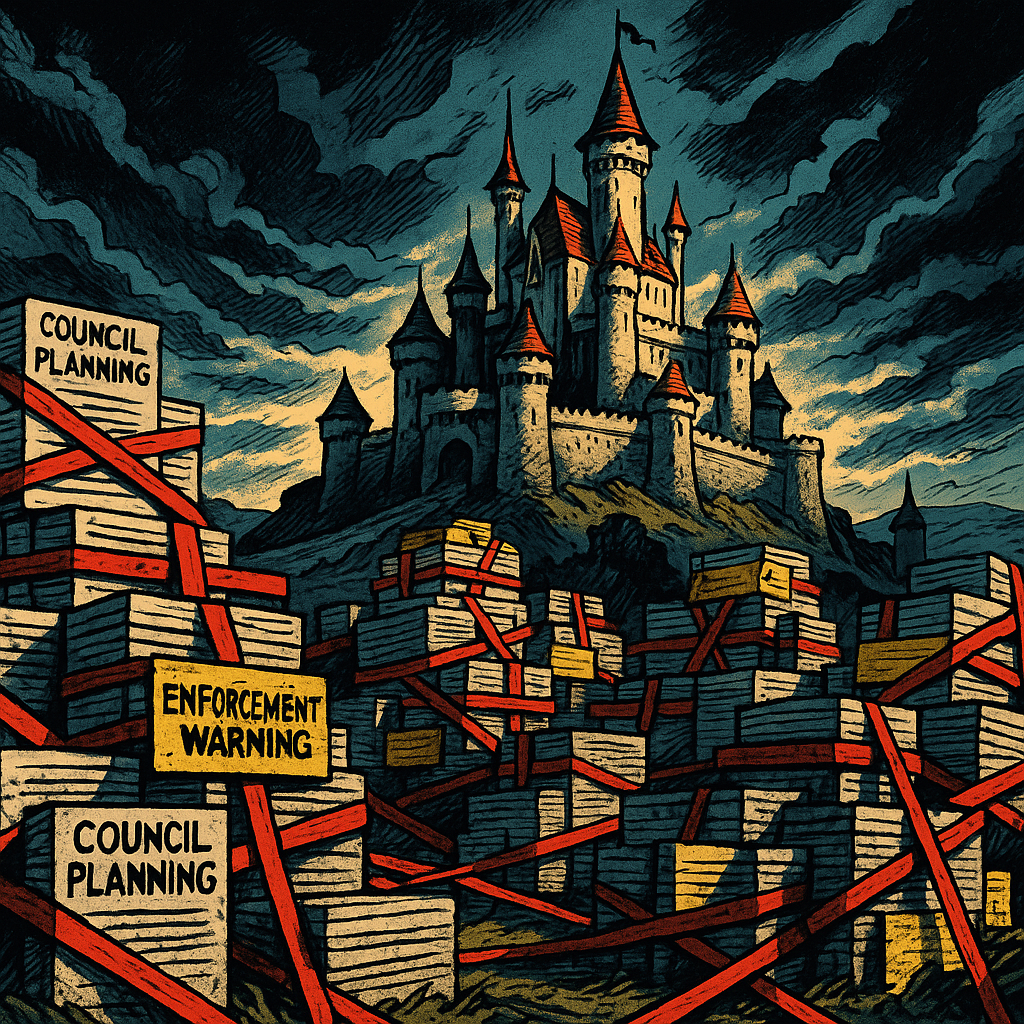
Hyrule: A Conservation Area Nightmare Waiting to Happen
Hyrule Castle alone would trigger approximately forty-seven separate consultations. The thing is enormous, it sits on what appears to be prime agricultural land, and its structural design (floating battlements, a moat that defies hydraulic logic) would have the Environment Agency absolutely furious within about a fortnight. Any application for a structure that visually dominates the surrounding landscape gets flagged immediately, and Hyrule Castle dominates everything within a 200-mile radius.
Then there’s the issue of Kokiri Forest. Protected woodland. Ancient trees. You cannot touch so much as a branch without a tree preservation order getting slapped on it, and some of those Deku trees have clearly been there since before the Roman occupation. The Lost Woods would almost certainly be designated a Site of Special Scientific Interest, meaning the only person allowed in is a DEFRA-appointed ecologist with a clipboard and a somewhat haunted expression.
Death Mountain? You’d need a geotechnical survey, a volcanic risk assessment, and probably a strongly worded letter from the Health and Safety Executive before you could even pitch a tent up there. The Gorons would be waiting years.
Rapture: Andrew Ryan Would Have Been Destroyed at the Planning Inquiry
Andrew Ryan built an entire city on the ocean floor to escape government interference. Lad. You cannot escape it. You just relocated the paperwork.
A subaquatic city of that scale would require a Marine Licence from the Marine Management Organisation, sign-off from the Crown Estate (since the seabed around the British Isles is technically Crown property), and a full Environmental Impact Assessment covering effects on marine ecosystems. The bioluminescent sea creatures alone would spark a Natural England intervention. The Art Deco architecture, while genuinely stunning, would probably get listed before it was even finished, meaning Ryan couldn’t modify a single neon sign without retrospective consent.
His libertarian utopia would collapse not under the weight of ADAM addiction or plasmid-fuelled revolution. It would collapse under a fourteen-week local consultation period, a missed statutory deadline, and a planning officer’s email that just says “further information required” with no further information about what further information is required. We’ve all been there.
Night City: Every Single Building Is Probably in Breach of Something
Night City from Cyberpunk 2077 is essentially a vertical sprawl of megabuildings, neon signage, and structures that appear to have been designed by someone who’d never heard of a building regulations inspection. The megabuildings alone, residential towers housing thousands of people, would require fire safety assessments under the Building Safety Act 2022. After Grenfell, the cladding situation in Night City would have every safety inspector in the country on site simultaneously, and rightly so.
The Badlands outside the city would be classified as brownfield land (toxic waste everywhere, abandoned infrastructure, general post-apocalyptic vibes), which actually means it would be prioritised for development under current government housing policy. Perversely, Night City’s dystopian wastelands might be the one bit of the whole franchise that breezes through planning. There’d be a press release from the council calling it “an exciting regeneration opportunity.”
The neon advertising hoardings, though. Every single one of those would need advertisement consent. Every. Single. One. There are approximately 900,000 of them. Good luck, Arasaka.
Midgar: Objections from Every Resident of Sector Seven
Final Fantasy VII’s Midgar is built on a plate, literally a massive disc suspended above the slums below, blocking all natural light from the lower city. If you tried to get planning permission for that in the UK, the objection letters alone would fill the Albert Hall. “Loss of daylight” is one of the most commonly cited grounds for planning objections in England, and Midgar takes loss of daylight to a genuinely dystopian extreme. The Planning Inspectorate would reject it within twenty minutes. Shinra Corporation would appeal. It would go to a public inquiry lasting three years. Cloud would be middle-aged by the time anyone made a decision.
The Mako reactors draining the planet’s life energy would also, one suspects, fall foul of the Environment Agency’s abstraction licencing rules. You can’t just drain a river without permission; draining an entire planet’s spiritual essence is presumably in a whole other category of enforcement action. The government’s planning guidance for England runs to hundreds of pages and somehow still wouldn’t cover this specific scenario, which tells you everything.
Tamriel: Listed Buildings, Everywhere, Forever
The Elder Scrolls universe is essentially one enormous Grade I listed building with some bandits in it. Dwemer ruins alone would be automatically protected under the equivalent of the Ancient Monuments and Archaeological Areas Act. You wouldn’t be able to excavate a Dwemer dungeon without a full archaeological watching brief, a report submitted to the Historic Environment Record, and six months of waiting for an archaeologist who is, themselves, still cataloguing stuff from the last dungeon.
Skyrim’s longhouses would probably fail Part L of the Building Regulations on energy efficiency grounds immediately. All those fires burning inside stone buildings with no insulation, single-glazed windows, and roofs that appear to be made of turf. The energy performance certificate would be an F. Possibly a G. The Jarls would be legally required to upgrade before they could rent them out.
Pac-Man’s Maze: Honestly, the Only One That Might Actually Get Approved
Think about it. It’s a contained structure. No visual impact on the surrounding landscape. No heritage concerns. It’s underground, so no overlooking issues for neighbours. The ghosts are technically existing residents with a right to remain. A few accessibility concerns under the Equality Act, perhaps, since the corridors appear to be exactly one person wide and there are no lifts, but nothing insurmountable.
Pac-Man’s maze might genuinely be the only iconic game world that could clear a UK planning committee without a single amendment. And that’s probably the funniest thing about any of this.
The real tragedy of all these video game worlds UK planning permission funny comparisons is that they reveal something true: the games we love exist precisely because they’re free from the bureaucratic friction that shapes every brick of the real world. No impact assessments, no neighbour objections, no enforcement notices taped to the door of Hyrule Castle. Just adventure, consequence, and the distant sound of someone heroically ignoring a building regulation.
Frequently Asked Questions
What is the funniest video game world that would fail UK planning permission?
Rapture from BioShock is a strong contender, since an entire subaquatic city would need a Marine Licence, Crown Estate approval, and a full Environmental Impact Assessment before a single Art Deco tile went down. Andrew Ryan literally built it to escape regulation, which makes the irony especially delicious.
Would Hyrule Castle actually be blocked by UK planning rules?
Almost certainly. A structure of that scale dominating the surrounding landscape would trigger a full heritage impact assessment, and its location on what appears to be protected farmland would cause serious headaches for the planning officer. The moat alone would need Environment Agency sign-off.
What UK planning rules would apply to Night City from Cyberpunk 2077?
The megabuildings would face scrutiny under the Building Safety Act 2022, particularly around fire safety and cladding. Every neon advertising sign would individually require advertisement consent, of which there are thousands. The Badlands, ironically, would likely be designated brownfield and fast-tracked for development.
How long does a UK planning application actually take?
A standard householder application should be decided within eight weeks, but major applications can take thirteen weeks or longer, and anything going to a public inquiry can take years. For something like Midgar’s plate structure, assume never.
Is this article actually about real UK planning permission rules?
The planning rules referenced are real, including the Building Safety Act, Marine Licences, tree preservation orders, and advertisement consent requirements. The game worlds applying for them are, sadly, fictional. Although Pac-Man’s maze genuinely might scrape through.